Trump Explains Hand Bruise: 'Clipped It' on Table
Emily Taylor ·
Listen to this article~4 min
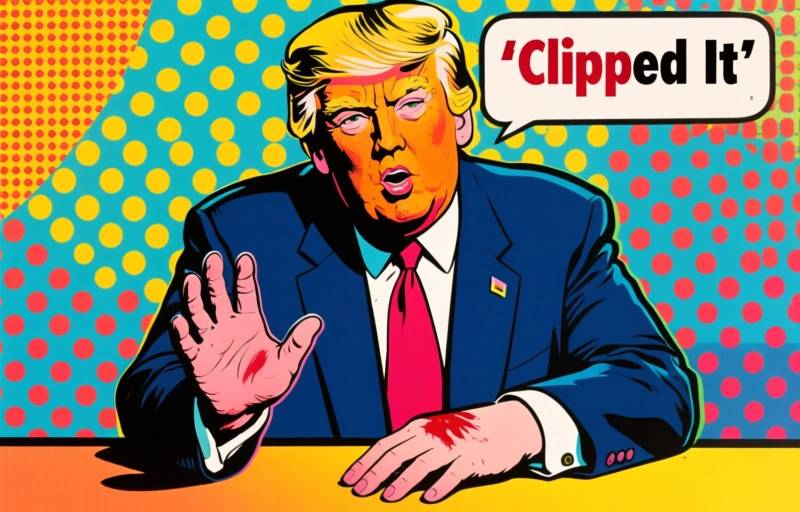
Donald Trump attributed a visible bruise on his hand to clipping it on a table. This common explanation highlights how minor, everyday incidents are magnified under public scrutiny and analyzed within broader narratives.
So, here's something that caught my attention recently. Donald Trump showed up with a noticeable bruise on his hand, and when asked about it, he had a pretty straightforward explanation. He said he simply 'clipped it' on a table. That's it. No dramatic story, no elaborate tale—just an everyday bump that left a mark.
It's one of those moments that makes you think, you know? Even people constantly in the spotlight have these ordinary, human moments. They walk into furniture, stub a toe, get a random bruise. It's oddly relatable, despite the vastly different contexts of our lives.
### The Anatomy of an Everyday Injury
Let's break down what 'clipping' a hand on a table really means. We've all done it. You're moving through a space, maybe you're distracted, and you catch the side of your hand—usually the metacarpal area—on a sharp table edge. It doesn't take much force. The skin and small blood vessels (capillaries) get compressed against the bone underneath.
When those tiny vessels break, blood leaks into the surrounding tissue. That's what a bruise is: a collection of blood under the skin. The body then gets to work cleaning it up, which is why bruises change color over time from purplish-blue to greenish-yellow as the blood breaks down.
- It's a blunt force trauma, but a minor one.
- The location on the hand often means there's not much fat to cushion the impact.
- This can make the bruise look more pronounced than a similar bump on, say, your thigh.
It's a perfect example of how a mundane action can have a visible consequence. For most of us, it's a non-event. But when you're a former president, every mark gets scrutinized.
### Why the Small Stuff Matters in Public Life
This is where it gets interesting for professionals who analyze public figures. A minor physical detail becomes a data point. It feeds into the broader narrative about a person's current state. Is the person healthy? Agile? Stressed and accident-prone? The public and the media instinctively try to connect dots, even when there might not be a bigger picture to see.
There's a quote that comes to mind here, though I'm paraphrasing: *'In the age of constant scrutiny, nothing is just a bruise; it's a story waiting for a headline.'* We live in that age. Every visible sign is interpreted, often beyond its simple cause.
For analysts, the key is separating signal from noise. The explanation—clipping a table—is perfectly plausible and common. The challenge is resisting the urge to inflate its significance without cause, while also acknowledging that in public perception, everything contributes to the mosaic of a persona.
### The Takeaway for Communication and Perception
What can we learn from this? First, simplicity often rings true. A complex excuse for a simple injury might raise more eyebrows than the injury itself. Second, it highlights the intense magnification of a public life. Things we wouldn't think twice about for ourselves become topics of discussion.
Finally, it's a reminder that human biology is a great equalizer. Bruises heal on the same timeline, whether you're a celebrity, a politician, or someone reading this. The body's process doesn't care about your job title. In a weird way, that's kind of comforting. It grounds these larger-than-life figures in the same physical reality we all experience.
So next time you get a random bruise, maybe you'll think of this. You're participating in a universal human experience, one shared by world leaders and everyday folks alike. Just maybe try to avoid the sharp corners of tables—they're unforgiving for everyone.