What Is Super-Clipping in F1 Racing? A Simple Guide
Felix Braun ·
Listen to this article~5 min
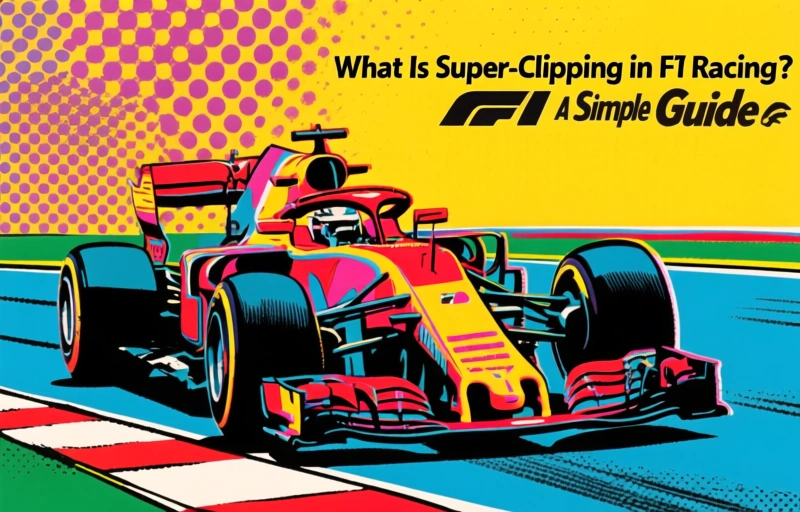
Super-clipping in F1 is an advanced energy management technique. Drivers briefly lift off the throttle to harvest a burst of power, ensuring a full battery for a maximum boost exiting the next corner.
You're watching an F1 race, and the commentators start talking about 'super-clipping.' It sounds technical, maybe even a bit intimidating. But what if I told you it's a concept you can grasp pretty easily? Let's break it down together, no engineering degree required.
Think of it like this. You know how sometimes you push a button on a remote and nothing happens until you press it just right? Super-clipping in Formula 1 is a bit like finding that perfect press, but for a car's hybrid power system. It's a specific, advanced technique drivers use to manage energy.
### The Heart of the Modern F1 Car
To understand super-clipping, we need a quick pit stop to look under the hood. Modern F1 cars are hybrids. They have a traditional internal combustion engine and a sophisticated battery system called the Energy Recovery System (ERS). This ERS captures energy that would normally be wasted—like under braking—and stores it in a battery. The driver can then deploy this stored energy for a power boost, often down a straight to help with overtaking.
Managing this energy is a huge part of a driver's job. They're constantly balancing harvesting energy and deploying it. Get it wrong, and you're a sitting duck on the main straight. Get it right, and you can pull off a stunning pass.
### So, What Exactly Is Super-Clipping?
Here's where super-clipping comes in. Normally, the system harvests energy when the driver lifts off the throttle or brakes. Super-clipping is a more aggressive method. It involves the driver briefly lifting off the throttle *even while still on a straight*, before a corner, to force the system to harvest a larger chunk of energy all at once.
Why would they do that? It's all about preparation. By 'super-clipping' and harvesting a big burst of energy just before a corner, the driver ensures the battery is fully charged and ready for maximum deployment as they exit that corner and accelerate onto the next straight. It's a tactical sacrifice of a tiny bit of speed entering the corner to guarantee a bigger rocket boost coming out of it.
> It's like taking one step back to get a running start for two steps forward.

### The Driver's Delicate Dance
This isn't something done on autopilot. It requires incredible feel and precision. The driver has to judge it perfectly. Lift off too much or for too long, and you lose too much time entering the corner. Don't lift enough, and you won't harvest the energy you need. It's a high-stakes balancing act performed at over 200 miles per hour.
Teams program different engine modes and harvesting strategies into the car's software. The driver, in constant communication with the engineer, chooses when to use these modes. Super-clipping is often part of a specific 'overtake' mode or used when defending a position, where having that guaranteed burst of power is critical.
### Why It Matters to the Race
This technical nuance has real-world consequences. It adds a layer of strategy that we, as fans, can listen for. When a commentator says a driver is managing energy or 'clipping,' it often means they're setting up for an attack or a defense a lap or two later.
- It creates strategic battles within the physical ones.
- It explains why a car might seem slow in one sector and then blisteringly fast in the next.
- It highlights the skill difference between drivers in managing complex machinery.
Next time you hear the term, you'll know it's not a mistake or a problem. It's a calculated move. A driver is playing the long game with their car's energy, banking power for the exact moment they need it most. It turns the car from just a fast machine into a tactical weapon, and understanding that makes watching the race even more fascinating. You start to see the mind games and the planning happening at lightning speed, and that's where the real magic of Formula 1 lives.